Nationwide Mobile Digital Billboard Truck Advertising

Blogs

How to Choose a Mobile Billboard Advertising Company: The Buyer’s Framework

How to Choose a Mobile Billboard Advertising Company?

Quick answer: To choose a mobile billboard advertising company, compare vendors on seven things: fleet size, the markets they actually serve, how they prove your campaign ran, creative capabilities, launch speed, pricing clarity, and who you’ll talk to mid-campaign. Be strictest about proof of performance. If a company can’t show you GPS-verified routes and photos from a real past campaign, keep looking.

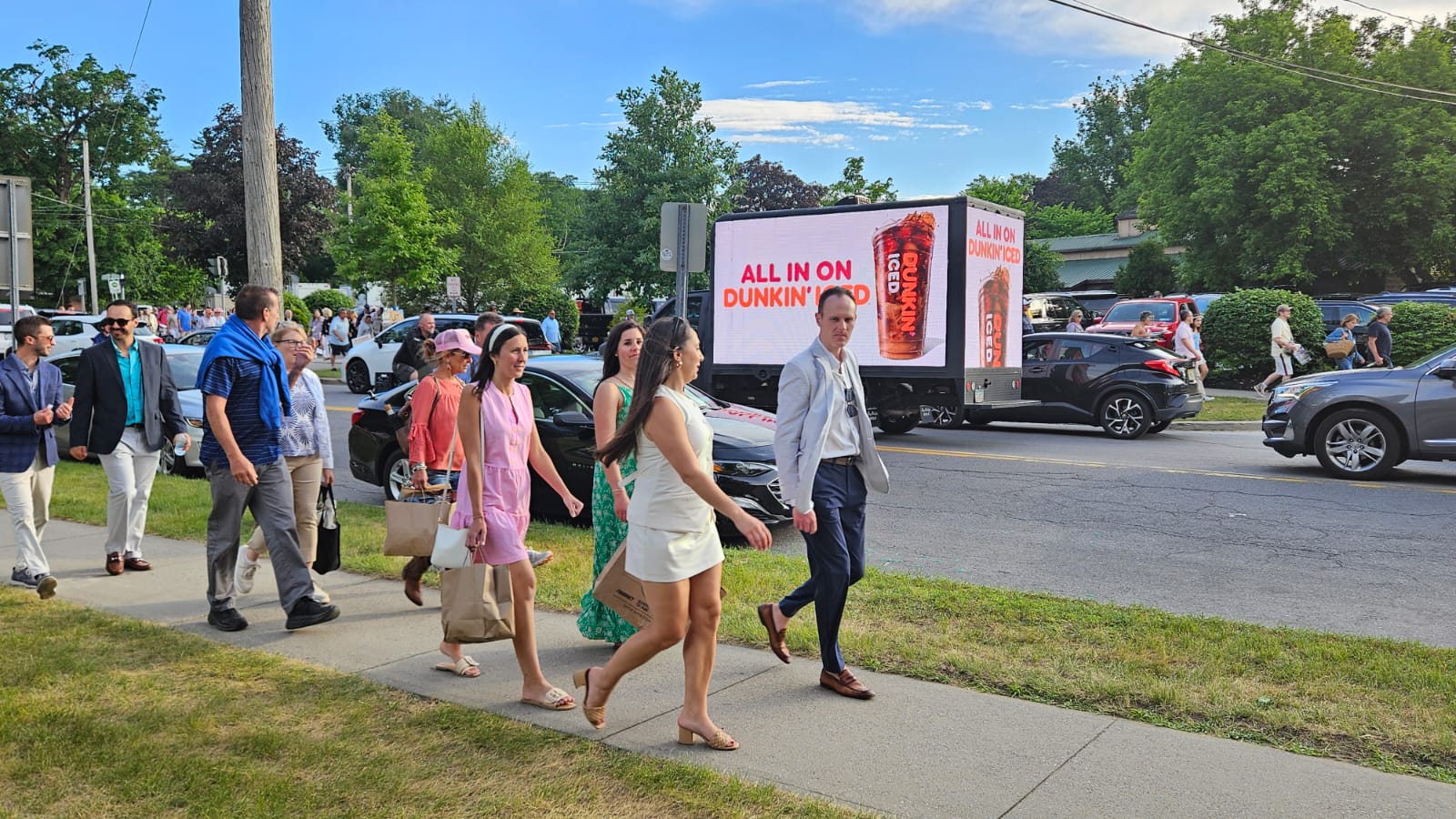
Fleet of digital mobile billboard trucks outside a side walk for a multi-truck campaign

Choosing a mobile billboard advertising company should be simple. It isn’t.

On the surface, every vendor looks about the same. Bright LED truck. Nice photo outside a stadium. A promise of “thousands of impressions.” The real differences show up later, after you’ve paid. A truck doesn’t show up in your second city. Or the report lands in your inbox and it’s a map screenshot and a guess.

Can’t Miss US has been running digital mobile billboard trucks since 2016. We’ve worked on more than 2,500 campaigns for brands, media agencies, political campaigns, and city governments. Along the way, we’ve learned what separates a campaign you can defend in a meeting from one you can’t. Some of it is obvious. A lot of it isn’t.

So here’s the framework we’d use if we were sitting on your side of the table. Use it on us. Use it on anyone.

1. Fleet Size: Can They Actually Show Up?

Fleet size sounds like a bragging number. It’s not. It decides what’s possible.

A company with a few trucks can do fine work in one city. Ask that same company to run three cities at once for two weeks, starting Thursday, and things get shaky. Dates don’t work. Trucks get borrowed. Drivers get subcontracted.

A bigger fleet gives you three things: multi-city campaigns that run on the same days, faster turnaround, and backup. That last one gets overlooked. Trucks are vehicles, and vehicles break down. If there’s no spare nearby, your campaign day just disappears.

Questions to ask:

  • What’s your total fleet size? (Not how many trucks are near you. Total.)
  • Do you operate these trucks yourselves, or book them through other companies?
  • Can you run campaigns in three cities on the same days?
  • What happens if a truck breaks down mid-campaign?

Where Can’t Miss US lands: We operate the nation’s largest fleet of digital mobile billboard trucks, with more than 100 trucks and backup trucks in every market we serve. That’s what makes simultaneous multi-city campaigns routine for us instead of a scramble.

2. Coverage: Real Markets, Not Just a List of Cities

Anyone can put a hundred city names in their website footer. (We have a long list too. We see the irony.)

What matters is whether a company has run campaigns where your audience actually is. That includes places beyond the top ten metros. Plenty of valuable audiences live in cities like Knoxville, Fresno, Grand Rapids, and Tuscaloosa.

Questions to ask:

  • Which markets have you run campaigns in over the past year?
  • Can I see photos or a report from a campaign in my city?
  • Do you cover secondary and smaller markets, or only major metros?
  • Are trucks based locally, or driven in from somewhere else?

That last question matters for your budget. When a truck has to travel in from another market, travel time can affect the rate.

Where Can’t Miss US lands: We run mobile billboard advertising nationwide across 200+ markets, from New York and Los Angeles to college towns and regional hubs. If your campaign needs a truck brought in from a nearby market, that shows up in your quote before you commit. You can browse real campaigns in our gallery to see where our trucks have been.

3. Proof of Performance: The Filter That Matters Most

GPS route map from a mobile billboard proof-of-performance report

A mobile billboard is only as valuable as your ability to show it happened. Your CMO, your client, or your campaign manager is going to ask where the money went. “The driver said it went great” is not an answer.

Red flags:

  • Impressions described as “typical” or “estimated,” with no method behind the number
  • No GPS data
  • Photos that clearly came from a different campaign
  • Reports that take weeks, or never arrive

Green flags:

  • GPS-verified routes
  • On-site photos and video of your ad in motion
  • A clear explanation of how impressions are counted
  • A sample report they’ll share before you sign
  • Reporting that follows OAAA standards

Where Can’t Miss US lands: Our campaigns come with proof of performance, including GPS route verification and on-site photos and video. For deeper measurement, our Detailed Impressions Report breaks results into total impressions, unique reach, frequency, daypart performance, and stop-and-dwell analysis, all built on OAAA-compliant methodology.

Here’s what that looks like in a real report. For a three-day campaign with the City of Milpitas, California, one truck drove 204 miles and generated 560.4K impressions. It reached 187.9K unique people at a 3x frequency. The report also showed the truck made 30 stops averaging 3.2 minutes each, and that 54% of impressions happened during the PM peak.

That’s the level of detail you should expect from any company you hire. If you want to understand the math behind numbers like these, we break it down in how to estimate the audience of a mobile billboard.

4. Creative Support: Are You on Your Own?

Some companies rent you a screen and wish you luck.

Designing for a moving LED truck is its own skill. People have roughly three seconds to get your message. Short headlines, bold contrast, and one clear call to action work. Dense copy doesn’t. A good partner will tell you that before your artwork goes live, not after.

Questions to ask:

  • Do you help with creative specs and best practices?
  • Can your trucks play full-motion HD video and audio, or only static images?
  • Can creative change based on time of day, location, or weather?
  • If we need to swap creative mid-campaign, how fast can that happen?
  • What’s your production timeline?

Here’s why dynamic creative matters. Picture a retail product launch. In the morning, the truck tells people the product is in stores today. After lunch, it switches to a limited-time discount. By evening, it’s promoting a launch event that night. Same truck, same route, three messages built for three different moments. A static billboard can’t do that.

Where Can’t Miss US lands: Our trucks carry eye-level, three-sided HD LED screens that play video, static artwork, and live-streamed content, with an external sound system. Our team handles creative upload and technical support. We’ve also built tools most fleets don’t offer. Proximity Based Artwork adapts your creative to where the truck is. Fleet Sync Play synchronizes playback across multiple trucks. Social Wall turns a QR code scan into on-screen audience engagement.

5. Launch Speed: How Fast Is Fast?

Some opportunities don’t wait. A competitor makes news. A conference announces a surprise keynote. A political race tightens in the final week.

“Fast” means different things to different companies, so pin it down.

Questions to ask:

  • What’s the fastest you’ve launched, from approval to a truck on the road?
  • When you say “launch,” do you mean trucks are driving with my creative running, or just that the booking is confirmed?
  • Do you work evenings and weekends?
  • Does a rush timeline change the price?

Where Can’t Miss US lands: We can launch campaigns in as little as 24 hours, depending on truck availability and whether your creative is ready. That’s a big reason event marketers and political campaigns come to us when the calendar is tight. We wrote more about when a 24-hour launch makes sense and how to plan one.

6. Pricing: Clear Numbers, No Guessing

Almost every mobile billboard company prices campaigns custom. That’s fair. One truck for one day in Tampa isn’t priced like a 30-day run in Manhattan. But “custom” shouldn’t mean mysterious.

Questions to ask:

  • What’s included in the daily rate? Driver? Fuel? Route planning? Reporting?
  • What costs extra?
  • Do longer campaigns or multiple trucks lower the daily rate?
  • What happens to the price if I change routes or dates?

Where Can’t Miss US lands: We publish our mobile billboard advertising costs so you have a starting point. Most campaigns fall between $1,200 and $4,000 per truck per day. One-day campaigns start at $1,800. Thirty-day campaigns usually run $1,000 to $1,500 per day. The rate covers the truck, fuel, a professional driver, the LED display, and campaign management.

Add-ons like geotargeting, retargeting, live streaming, and dynamic artwork are quoted separately, so you see them before you sign. Final pricing depends on your market, campaign length, creative format, and demand around major events.

7. Support: Who Picks Up When Something Changes?

Campaigns run on real streets. Traffic happens. Events get moved. Roads close around stadiums. You need to know exactly who you’re calling.

Questions to ask:

  • Who’s my main contact while the campaign is running?
  • How do I reach them? Phone, email, live chat?
  • Can routes or creative change once the campaign starts?

Where Can’t Miss US lands: Before launch, a campaign specialist reviews your goals, routes, and timing with you. During the campaign, you can reach our team by phone, email, or live chat, and routes and creative can be adjusted when plans change. For more on route planning, see how to choose winning routes for your campaign.

The Mobile Billboard Company Checklist

Score each vendor from 1 to 3 on every row. If a company scores a 1 on proof of performance, cross it off, no matter how good the price looks.

What to Evaluate The Minimum What The Best Companies Offer Ask Them
Fleet Size
Enough trucks for your dates, plus a backup plan
200+ trucks and simultaneous multi-city launches
“What’s your total fleet? Can you run three cities at once?”
Coverage
Proven campaigns in your markets
200+ markets, including secondary cities
“Where have you run campaigns this year? Can I see examples?”
Proof of performance
GPS route data and on-site photos
OAAA-compliant reports with reach, frequency, and dwell data
“Can I see a sample report?”
Creative
HD video and help with specs
Creative that changes by time, location, or weather, plus mid-campaign swaps
“How fast can we change creative?”
Speed
A firm launch date
Launch in as little as 24 hours
“What’s your fastest launch from approval to the road?”
Pricing
A written quote that lists what’s included
Published price ranges and add-ons quoted upfront
“What’s included, and what costs extra?”
Support
A team that answers
A campaign specialist, plus route and creative changes mid-flight
“Who do I call if something changes?”

What This Looks Like at Scale: Jobs Ohio

Three-sided LED mobile billboard truck fleet screen showing HD video at eye level

JobsOhio needed visibility in three Ohio cities at the same time. Can’t Miss US put 17 digital mobile billboard trucks on the road across Columbus, Cincinnati, and Cleveland for three days.

Here’s what the OAAA-compliant post-campaign report showed:

  • Total: 4.6 million impressions and 444K+ unique reach
  • Cleveland (7 trucks): 1.97M impressions, 164.4K unique reach, 12x frequency
  • Columbus (5 trucks): 1.38M impressions, 140K unique reach, 9.9x frequency
  • Cincinnati (5 trucks): 1.25M impressions, 140K unique reach, 8.9x frequency

Why does this matter for choosing a company? Seventeen trucks in three cities on the same days is a fleet size question. Reach and frequency broken out by market is a proof of performance question. A campaign like this needs both. A company that only has one of them can’t deliver it.

Put Every Vendor Through the Framework

Use this framework on every mobile billboard company you’re considering, including us. Score them honestly.

The companies that hold up on proof, speed, and scale are worth a serious conversation. The ones that get vague on any of those usually end up costing more than the invoice says.

If you want to see how Can’t Miss US measures up, request a free custom quote. We’ll walk you through a sample proof-of-performance report, real campaign data, and what a launch would look like in your markets.

Frequency Asked Questions

What is the largest mobile billboard company in the US?

Can’t Miss US operates the nation’s largest fleet of digital mobile billboard trucks, with more than 100 LED trucks serving 200+ U.S. markets. Founded in 2016, the company runs local, multi-city, and nationwide campaigns and is a member of the DPAA and MOOHA.

How much does it cost to hire a mobile billboard truck?

At Can’t Miss US, most campaigns cost $1,200 to $4,000 per truck per day. One-day campaigns start at $1,800, and 30-day campaigns typically cost $1,000 to $1,500 per day. Market, campaign length, creative format, and event demand all affect the final price.

How fast can a mobile billboard campaign launch?

Can’t Miss US can launch a campaign in as little as 24 hours, depending on truck availability and creative readiness. Many other providers need more lead time, so ask every vendor for their fastest confirmed launch.

How do I know my mobile billboard ad actually ran?

Ask for proof of performance before you book. A reputable mobile billboard company provides GPS route verification and on-site photos or video. Can’t Miss US also offers a Detailed Impressions Report covering impressions, unique reach, frequency, daypart performance, and stop-and-dwell data.

Is LED truck advertising the same as mobile billboard advertising?

Mostly, yes. “Mobile billboard” can describe any truck carrying an ad, including older trucks with printed static panels. “LED truck advertising” and “digital mobile billboard trucks” refer specifically to trucks with digital screens that play video, rotate messages, and update creative remotely.

Do I need a permit to run a mobile billboard?

It depends on the city. Rules vary across the U.S., so check local requirements before your campaign starts. We cover this in more detail in what permits are required for mobile billboard advertising.

About the Author
Mizba Lakdawala-Sajan

Mizba Lakdawala-Sajan

Mizba Lakdawala-Sajan is the Digital Marketing and Sales Manager at Can’t Miss US, a nationwide mobile digital billboard advertising company operating the largest fleet of LED billboard trucks in the United States. She oversees campaign strategy, client partnerships, and national rollouts that help brands achieve high-visibility exposure in real-world environments.

With experience in sales leadership and digital marketing execution, Mizba works closely with brands, agencies, event organizers, and political campaigns to design mobile billboard advertising strategies that deliver measurable reach and documented proof of performance. Her expertise focuses on route optimization, event-driven visibility, and multi-market campaign coordination.

Through Can’t Miss US, she helps organizations leverage mobile LED billboard trucks to bring their message directly to high-traffic areas, events, and city corridors across the country.